


When Austria played at the Under-17 World Cup, the players would undoubtedly have known that opportunity was there at their door.
The U17 World Cup is one of the most heavily scouted tournaments in the world. In many cases, the biggest and best players will already be known, with some of them having future deals in place before they arrive, and certainly Ifeanyi Ndukwe was coming into the tournament already known for his sheer physique.
Standing at 1.98m and with that Mo Salah-esque distinctive hairstyle adding another 10cm+ on top of that, Ndukwe was certainly easy to spot from a scouting perspective.
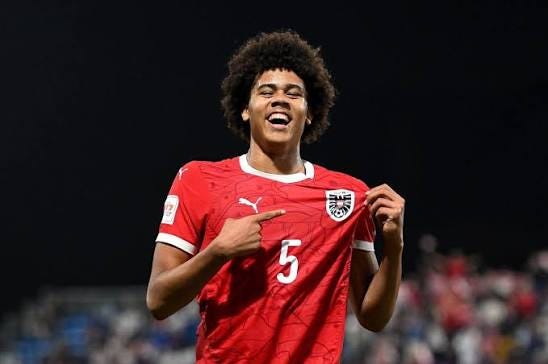
Liverpool FC were quick to act on the 17-year-old who was playing his trade at Austria Wien, initially striking a deal to sign Ndukwe in the January of 2026 for around 3m Euro according to Transfermarkt, though undoubtedly there will be bonuses and extras built into the deal.
However, the legal complexities begin from this point. Let us now take this saga from here.
Why couldn’t Ndukwe sign in January?
The primary reason for this is that Fifa have a rule in place around the transfer of minors.
Under FIFA regulations (Article 19 of the Regulations on the Status and Transfer of Players), international transfers of players under 18 are strictly prohibited unless they meet specific, pre-approved exceptions, such as parental relocation for non-football reasons or intra-EU/EEA moves for players aged 16 to 18.
Ndukwe turned 18 in March 2026, so the deal in January was always geared towards him arriving at Liverpool in the summer. He couldn’t move outside of a player registration window, so the summer was the first chance to get Ndukwe registered to Liverpool.
You may have noted that there was an easy way by which Ndukwe could’ve moved straightaway, via the European Union. This leads us onto our next point.
What affect has Brexit had on this transfer?
The short answer: a lot.
In the initial stage, it has prevented this deal being done straight away. Ndukwe could’ve been signed by Liverpool, or another UK club, since Summer 2024, if the UK was still part of the EU.
Freedom of Movement was a key tenet of the European Union, and, as quoted above, this trumps the FIFA regulations.
Pre-Brexit we did indeed see a lot of 16-year-olds move into the UK, especially in those premium Category 1 academies. The likes of Cesc Fabregas, Gerard Pique, and many others would fit into this route.
Once Brexit was finalised in 2020, this route was closed to English and Scottish clubs, and a new set of regulations was brought in.
What is GBE and why does Ifeanyi Ndukwe not hit the GBE pass?
Well, if you are reading this and you don’t know much about GBE, you are in the right place.
I would recommend that you read these two pieces if you want the depth in the regulations.

ESC for Under 23s only: 2026/27 GBE Changes for Men's Game

It is one of the most vital functions of the GBE Expert Hub that we are here to break down, and keep people updated about the changes that are made to the GBE and ESC legislation each year.
The basics are that a player needs 15 GBE points to gain an endorsement from The FA, which recommends to the Home Office that the player should get an international sportsperson work permit.
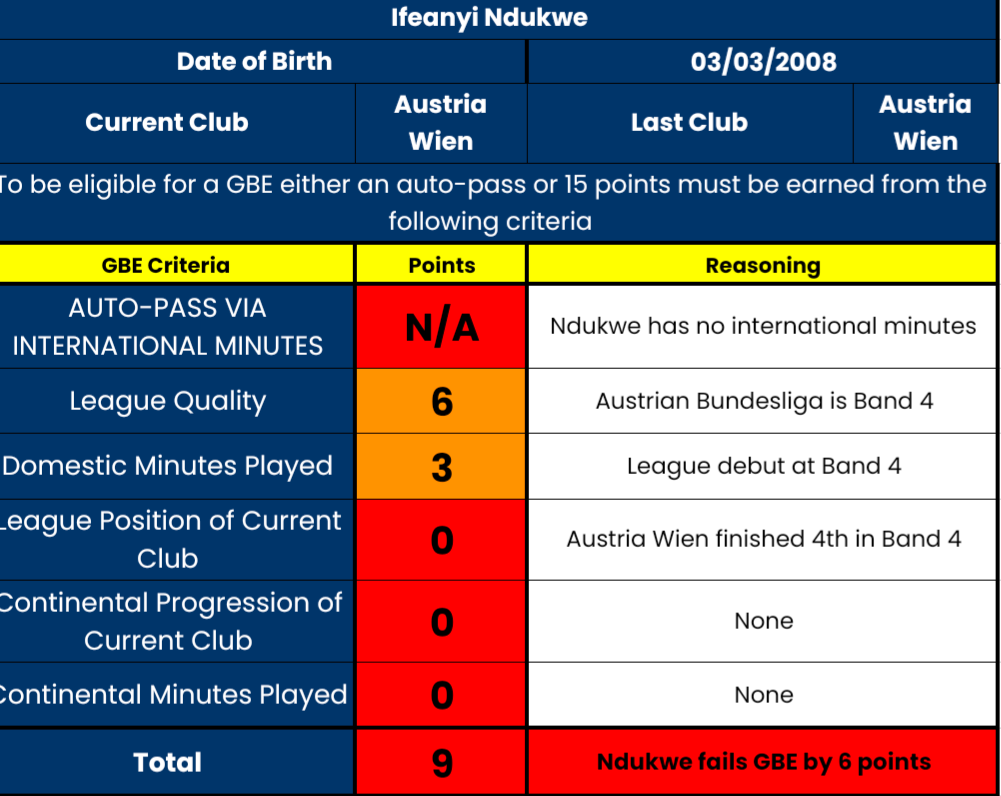
The points are built up over a Reference Period of the last twelve months, and, in this case Ndukwe doesn't get anywhere near 15. If he had gotten to 10, then he could have been taken to Exceptions Panel where Liverpool could have pleaded their case to The FA for a full work permit.
I calculate Ndukwe’s points as the following:
For many players who don't get GBE, they do usually get ESC, but that hasn't been possible for Ndukwe and Liverpool.
Why can't Liverpool use an ESC slot for Ndukwe?
Elite Significant Contribution (ESC) was introduced by The FA in Summer 2023 as an answer to the problem discussed above, whereby Premier League clubs especially, felt like they were losing out on young talent because they weren't able to get the 15 pts early in their careers.
Again, we have in depth articles on ESC on the site that I would recommend you read if you are not familiar with the concept of ESC.

The whole premise of ESC is that if you have a player who doesn’t hit the GBE points pass or auto-pass earned by international appearances then you can designate a “slot” in your registered squad to that player. This enables them to get a GBE for a work permit.
However, the number of ESC slots available in each club is limited. For Premier League clubs, that number is limited to a maximum of four. Liverpool do not have access to the full four though, indeed, they had no slots available to use on Ndukwe.
The player himself is able to pass ESC criteria as demonstrated below:
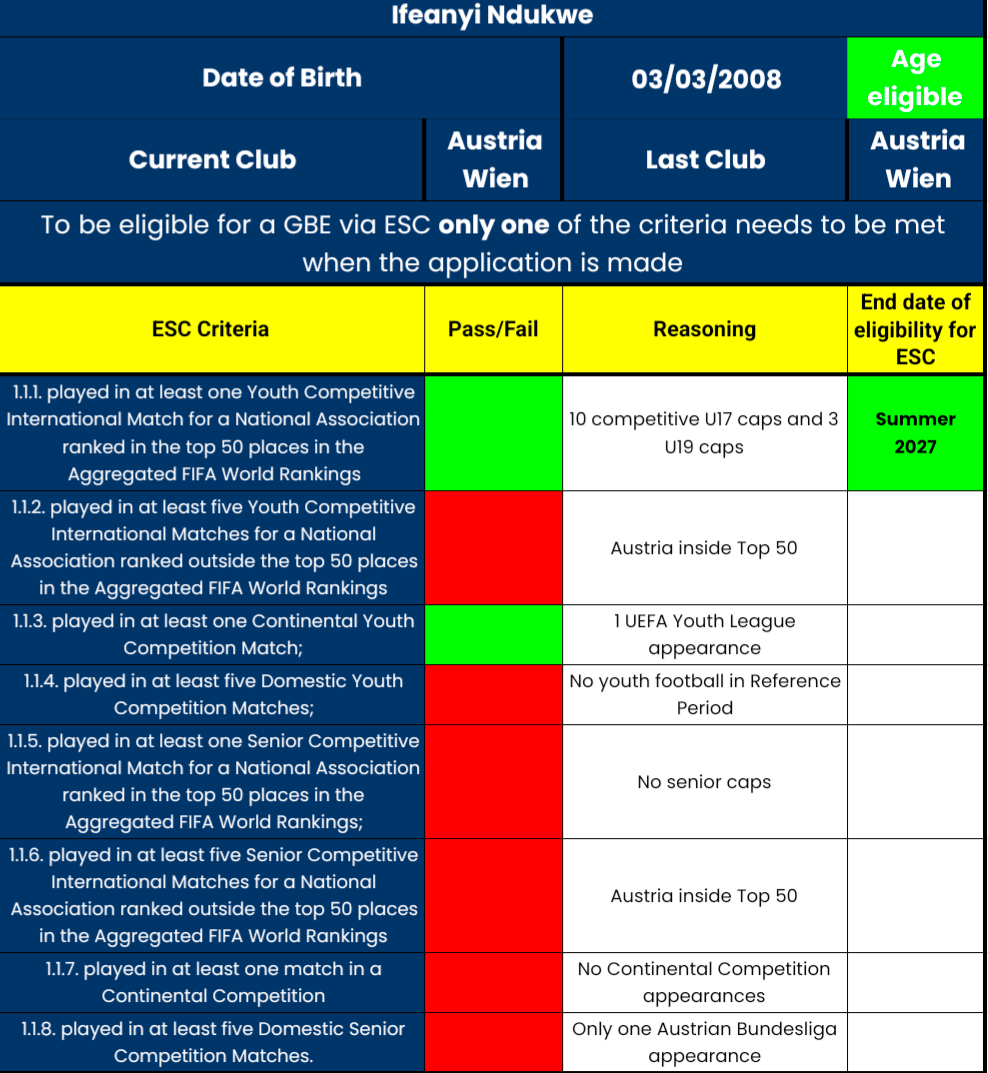
But Liverpool are restricted in their slots as a result of having given too few of their minutes to English Qualified Players (EQP).
For a club to retain a full complement of four ESC slots then they need to be giving 35% of their qualifying minutes (mostly Premier League minutes) to players who could, potentially, play for England.
The reality is that very few Premier League clubs do this, as the image below shows:
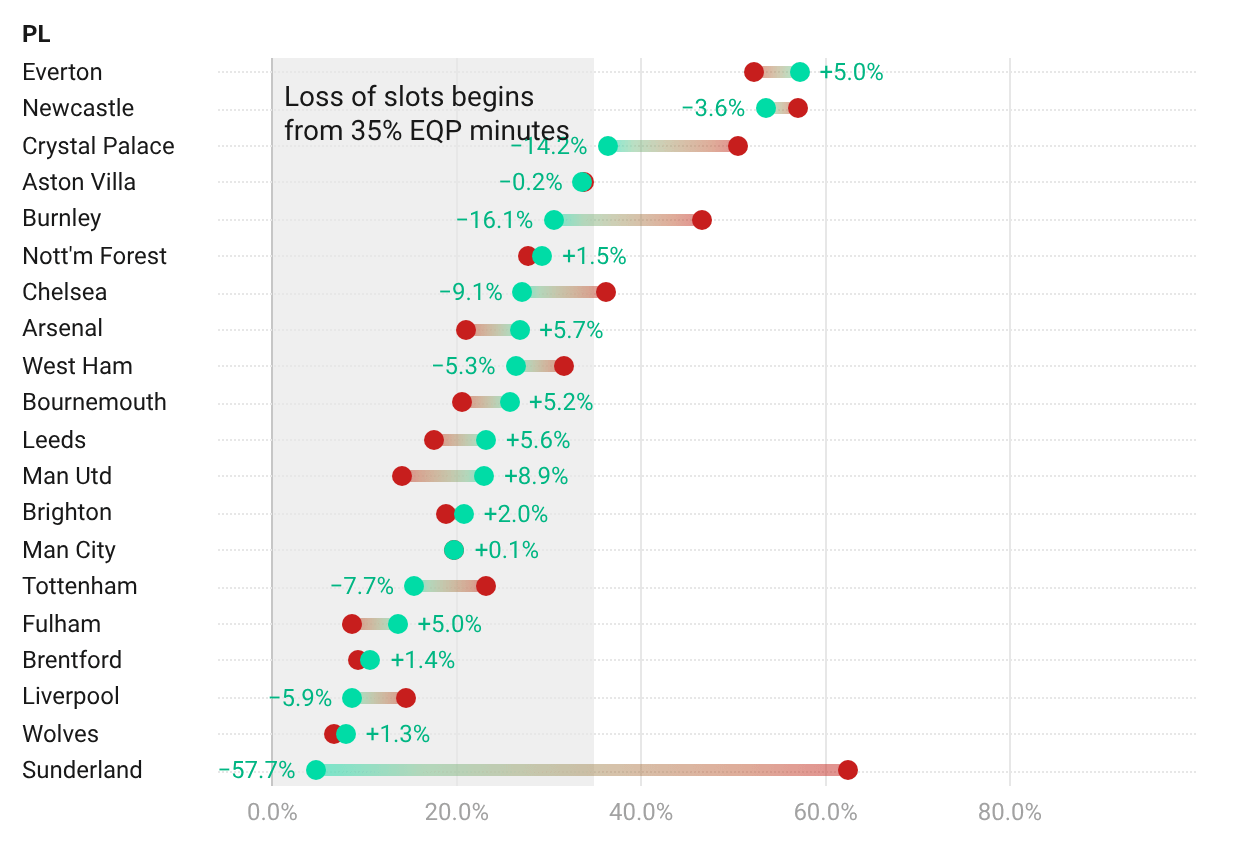
But Liverpool’s percentage of EQP minutes from the Premier League last year is one of the lowest in the league, with none of their key players being English. Only six eligible players took to the field for Liverpool last season, whilst only Curtis Jones played more than 600 minutes, and Jones himself is now expected to leave the club.
There are ways of earning slots back though. If a club provides three players for England over the last two years, or three players for the U20/U21 side. Liverpool have had Harvey Elliott fulfilling the criteria for the U21s, but no-one else.
We at GBE Expert Hub therefore believe that Liverpool are extremely limited on their slots, and we also know that they must have used one on fellow teenage centre-back Mor Talla Ndiaye.
Ndiaye was another defender who stood out in the U17 World Cup, but he was taken directly from Amitie FC in Senegal. I would guess that the reason this deal was completed in January, rather than Ndukwe, is because Ndiaye was already 18 at the time and could come straight to the club to begin his development.
However, because they used an ESC slot on Ndiaye, there hasn't been one available to use for Ndukwe.
Ndiaye will remain in an ESC slot until at least January 2027. If he passes GBE at that time then he could transition to a full GBE and that slot would become available for use again, unless Liverpool weren't entitled to any slots because of their lack of EQP and supply of England players.
For Ndiaye to pass GBE he will likely also have to go out on loan to a Band 1 or Band 2 league, the same as is planned for Ndukwe.
Why does a loan to Levante make sense for Ndukwe?
The key for Liverpool is to get Ndukwe to get the 15 GBE points to get him a work permit for the next player registration window in January.
A loan to Levante, plying their trade in La Liga fits the bill because La Liga is a GBE Band 1 league. This also applies to the German Bundesliga, French Ligue 1, and Italian Serie A.
Band 1 leagues bestow an automatic 12 GBE points on a player playing in that league, and then once Ndukwe makes a league debut for Levante he will receive a further 6 GBE points. This is because Ndukwe is treated as a “youth player” and is eligible for the points for a league debut under that status.
This is obviously gives him 18 GBE points come January, at which point he could return to Liverpool and the Home Office process for a work permit can begin. He could yet earn more GBE points if he played over 60% of available minutes for Levante, but it wouldn't actually be necessary because 15 is all that is required.
From the moment a work permit is bestowed upon Ndukwe he can then play competitive matches for Liverpool.
Why was Ndukwe allowed to play friendly matches this summer?
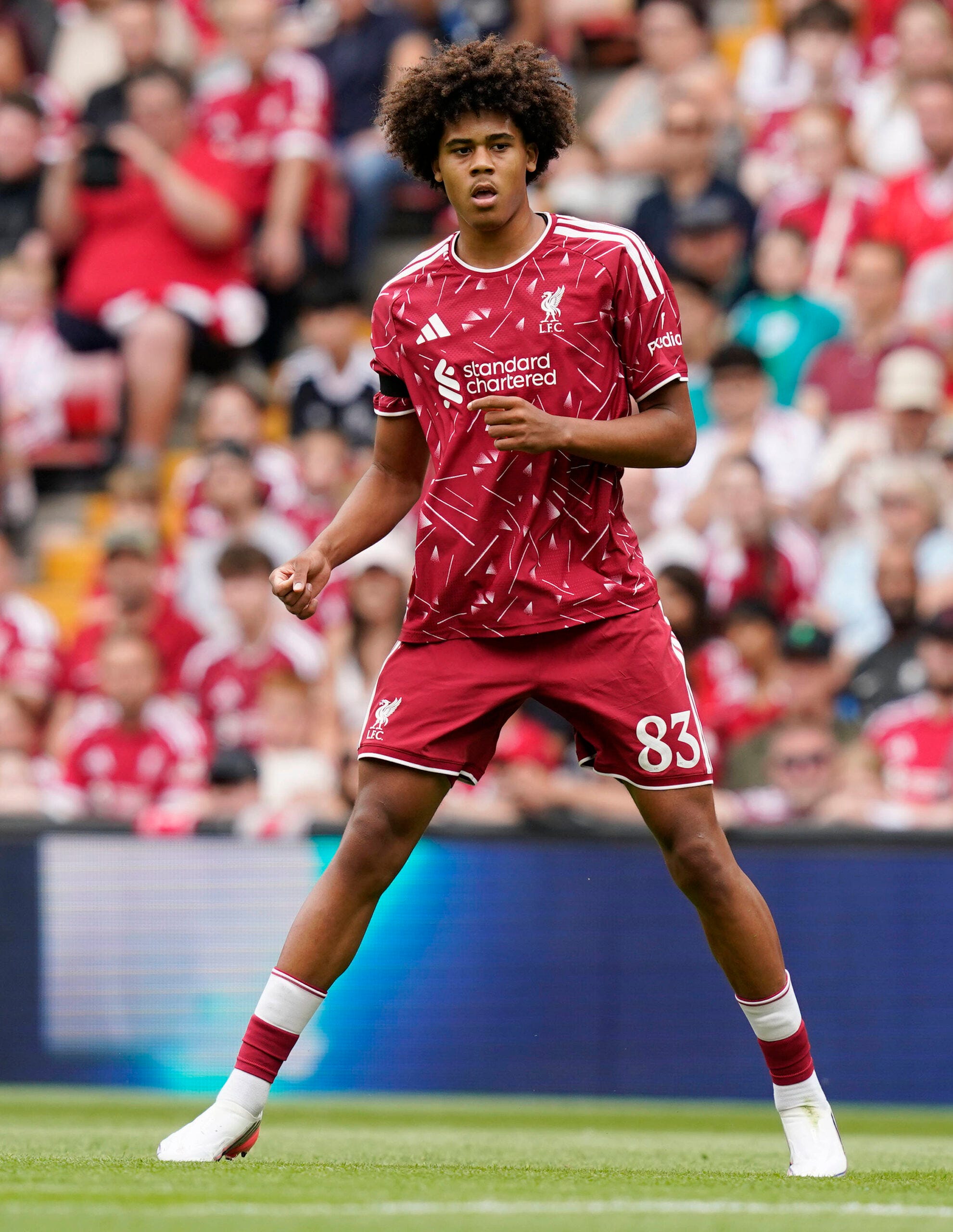
Ordinarily a work permit is required to do any work for an employer in the UK if you come from overseas.
Initially this stumped me somewhat when considering this case, but upon research I suspect that Ndukwe was allowed to come over post-signing in July on a standard visitor visa in order to come and play in the non-competitive games.
The fact that they are non-competitive is the distinction here because otherwise this wouldn't have been allowed under the regulations.
It is clear that Liverpool have a talent on their hands here, and although they are having to jump through a lot of hoops to finally make him a Reds player, I think it will be worthwhile for them.
Of course, this would have all been a lot simpler pre-Brexit, but that is the nature of bureaucracy in a post-Brexit world.
Liverpool might also find these dealings easier if they had more breathing room from an ESC slot perspective. However, they just don't seem to have the quality of English player, and don't seem to be interested in signing any, to improve that EQP percentage.
Rio Ngumoha is obviously a player who will contribute minutes, and give them England representation, but the sale of Curtis Jones harms that at the same time.
We will continue to watch this deal closely and see if this style of transfer is replicated elsewhere in the Premier League.